The Bible's story of the birth of Jesus
by Steve Rudd
|
|
Separating the Bible truth from the Myth |
Quick links in this document:
II. Strictly Biblical chronology of the birth of Christ.
III. The date of the birth of Christ is 2 BC not 6 BC:
IV. The Census of Quirinius in 3 BC not 6 AD: Lk 2:1-3
V. Jesus was born in a house not an Inn: Lk 2:7
VI. The archeology of the first century four room house in ancient Israel:
VII. Where did the star lead the wise men (Magi): Bethlehem or Nazareth?
VIII. What is the date of Jesus' Birthday?
IX. Mary and Joseph: Marriage, betrothal, divorce and other personal matters.
X. Focus on the risen Christ, not a baby in a manger. He's not there. The baby grew up!
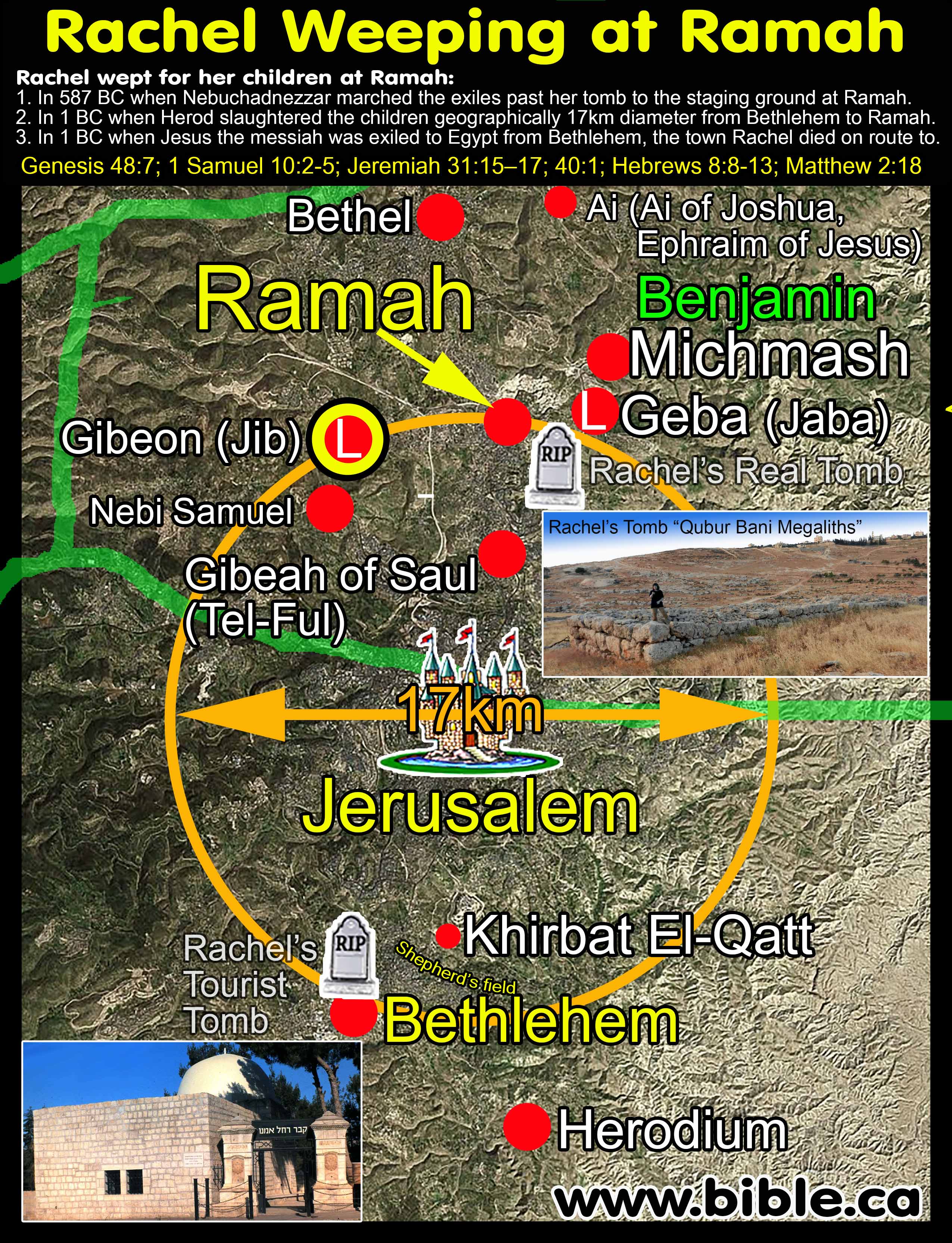
See full outline on Rachel weeping from Ramah.
Introduction:
The birth of Jesus Christ is in direct fulfillment of many Bible prophecies, Isaiah 7:14 of the virgin birth; Gen 3:15 that he was born of the seed of woman, Isaiah 11:1 that he would descend from the line of Jesse (king David); Micah 5:2 that he would be born in Bethlehem; Matthew 2:18 + Jeremiah 31:15 that Herod would slaughter all the children in an attempt for the Devil to kill the Christ child. All these prophecies were made at least 700 years before Jesus was born. They stand as an irrefutable monument to the inspiration of the Bible and prove that God revealed himself through his messiah, Jesus of Nazareth.
MYTH #1: Christmas on December 25th is found in the Bible.
TRUTH: There is no celebration
of the birth of Christ in the Bible on any day, but began through human
tradition to be celebrated about 250 AD in the spring and on December about 325
AD.
See also: Pagan
origin of Christmas, Easter, Halloween "holy days".
MYTH #2: December 25 is the birthday of Jesus.
TRUTH: December 25 was the birthday of Mithra, the pagan God of light. In 325 AD, Roman emperor Constantine re-assigned the meaning to the birthday of Jesus, the true God of light. The Christian meaning over
MYTH #3: Mary wanted to spend the night at an inn, but there were no "motel rooms" available because the inn was full.
TRUTH: There was no space (room) in the "upper room" of a private house because other family members had got there first, not a public inn, motel, hotel etc.
MYTH #4: Mary remained a virgin until the day of her death.
TRUTH: Although Joseph did not have sex with Mary until after she gave birth to Jesus, Mary and Joseph had many other children: “Is not this the carpenter’s son? Is not His mother called Mary, and His brothers, James and Joseph and Simon and Judas? “And His sisters, are they not all with us? Where then did this man get all these things?” (Matthew 13:55-56)
MYTH #5: They spent the night in a separate building like a barn where the animals were kept.
TRUTH: There was no room on the upper floor of the house so they spent the night on the main floor of the house where the animals were kept inside the house. Most ancient Jewish houses had a common area on the main floor, including a manger where animals ate and slept at night, and an upper room where everyone slept. It is possible that there was a separate barn, but this would often be attached to the house directly.
MYTH #6: There were three wise men.
TRUTH: There were three gifts, gold frankincense and myrrh. There may have been 10 wise men, we don’t know, but each of them likely brought some gold frankincense and myrrh. Since these were common currency items of value, each wise man, regardless of the actual number, brought a little of all three.
MYTH #7: The star of Bethlehem shone over the manger the night Jesus was born.
TRUTH: The wise men did not come to Jerusalem until after Mary had purified on day 33 after the birth of Jesus. It was at that point the star began to move slowly ahead of the wise men till it hovered over the place Jesus was located. This means that the star was not hovering over Jesus the night he was born. The star shone over a house, not a barn or an inn. "And they came into the house and saw the Child with Mary His mother" (Matthew 2:11). It is never called "the star of Bethlehem", simply, "His star". The shepherds were directed by an angel (not a star) to the manger of Jesus the night he was born. The star led the "wise men from the east", who traveled at least 700 km from the Persian or Babylonian area, to the house of Joseph and Mary. This trip would take at least 30 days after the birth of Jesus when you average 25 km per day travel time. After Jesus had been circumcised on the 8th day in the temple, and Mary performed her purification on the 33rd day, Jesus may have been taken to Joseph's home in Nazareth and this is where the star led the wise men: “When they had performed everything according to the Law of the Lord, they returned to Galilee, to their own city of Nazareth.” (Luke 2:39). The star, therefore, might have shone over Nazareth, not Bethlehem. The flight to Egypt did not happen until after Mary's purification on the 33rd day. Only after this did the Magi arrive in Jerusalem. They were directed to Bethlehem, not by the star, but because Jewish authorities quoted Micah 5:2. However, the redirection of the Magi to an alternate return route coupled with the same hour of the night urgent departure, both lend weight to the star leading the Magi to the same house Jesus was born.
MYTH #8: The wise men arrived the night Jesus was born in a manger.
TRUTH: The shepherds came to the manger (Luke 2:8-10), but not the wise men came to Joseph's house. In fact, Herod orders the slaughter of the babies two years of age and younger. This means that the child would be well under two years old, in order that no error could be made in killing Jesus, but it also indicates that Jesus was older than a newborn.
MYTH #9: God wants Christians to remember and celebrate the birthday of Christ!
TRUTH: The scriptures do not tell us to celebrate the birth of Christ but to celebrate His death... and not once a year at "Easter" but every Sunday through the Lord's Supper. (Acts 20:7)
MYTH #10: Christ was born in 6 BC!
TRUTH: Josephus and other sources show Christ was born in 3/2 BC. (see details below)
MYTH #11: Luke got it wrong because the census of Luke 2:1-3 occurred in 6 AD!
TRUTH: Josephus got is probably confused and wrong. Luke is right! The census took place in 3 BC.
II. Here is a strictly Biblical chronology of the birth of Christ.
1. Mary and Joseph were fully and legally married when Mary became pregnant. She is referred as his wife and Joseph considered "divorcing" her.
2. Joseph was called a "just man" in wanting to divorce Mary privately because he was willing to pay the "bride price", (a large sum of money) to divorce her for no cause… when he actually had cause! How many men would care about the reputation of their "harlot" wife, whom they feel has committed adultery on him, then pay $25,000 to the father of the "Harlot" wife. When he was willing to divorce his wife secretly, he, not her, would look bad. He had certain proof she was unfaithful and could divorce her with no cost to himself. “And Joseph her husband, being a righteous man and not wanting to disgrace her, planned to send her away [divorce] secretly.” (Matthew 1:19)
3. Mary was a virgin when she conceived Jesus through the Holy Spirit.
4. Caesar Augustus takes a census around 3 BC which triggers pregnant Mary and Joseph to travel to Bethlehem. (Luke 2:1-3)
5. Mary and Joseph were members of the "house of David" and Jesus was born in their ancestral town of Bethlehem where David was born: “Joseph also went up from Galilee, from the city of Nazareth, to Judea, to the city of David which is called Bethlehem, because he was of the house and family of David,” (Luke 2:4)
6. Joseph and Mary tried to stay of a relative's house, not a public inn, but there was no space left in the "upper room" (mistranslated inn in many Bibles).
7. Joseph and Mary were forced to sleep on the ground floor (directly below the upper room of the private home) where the animals slept.
8. Jesus was born on the main floor of a relatives two story house because there was no room for Mary and Joseph to stay in the "upper room", in Bethlehem (Matthew 1:25 & Luke 2:1-7).
9. That same night, angels announced to the shepherds that Christ was born and they visited the newborn Christ at the manger (Luke 2:8-20).
a. In this way, all shepherds, who as a class had a very low social status, would take a keen and early interest in the Chief Shepherd (Jn 10:11; 1 Pet 5:4). Jesus is the "lamb ... who will be their shepherd" in Rev 7:17.
b. It was fitting for many reasons that God designed that shepherds be the first to hear the gospel. All the patriarchs, Abraham, Isaac and Jacob etc., were shepherds.
c. King David was a shepherd, and was not originally even considered a candidate as king. Jesus was the "good shepherd" (Jn 10:1ff).
d. The office of overseers of the local churches (1 Tim 3; Tit 1) uses two other interchangeable words to describe the single office: Elders and Shepherds. (Acts 20:17,28; 1 Peter 5:1-2).
10. Jesus was circumcised when He was eight days old (Luke 2:21). Jesus was then presented in the temple 33 days later after the "days of purification" were competed, which is the 40th day after Jesus was born. (Leviticus 12:2-6 & Luke 2:22-38).
a. This lends support to the idea that Jesus would stay in the same family home that Jesus was born in until the 33rd day.
b. Given all the attention surrounding the birth, those living in the house would be very pleased to accommodate Joseph, Mary and Jesus.
11. Contrary to popular myth, the "star of Bethlehem" is merely referred to as "his star" which the Magi saw.
a. The star hovered over the same house where Jesus was born. (See Matthew 2:11) Matthew 2:1-2,7,9 says "Now after Jesus was born in Bethlehem of Judea in the days of Herod the king, behold, magi from the east arrived in Jerusalem, saying, "Where is He who has been born King of the Jews? For we saw His star in the east, and have come to worship Him. ... Then Herod secretly called the magi, and ascertained from them the time the star appeared ... the star, which they had seen in the east, went on before them, until it came and stood over where the Child was"
b. The Magi first saw the star at the time of Christ's Birth, then they saw the star long after Jesus was born and arrived at the house of Jesus, probably when Jesus was about 5-9 months old. (see below)
c. There is no evidence that the Magi were led to Jesus by a bright low hovering star. Such a star would have been quite noticeable by many people. The fact that Herod had to ask the Magi when the star first appeared, proves that the star was not out of the ordinary to the untrained eye. Only the Magi, who studied the stars, would notice it. Hence the idea of a very bright low hovering star shining over the stable where Jesus is born is unlikely.
d. On the other hand, the star the Magi were attracted by, has no acceptable natural celestial explanation and it is clearly a special miracle to attract the Magi.
12. An unknown number of wise men (Magi), visited Jesus at his “birth house” (Matthew 2:1-12).
a. This is probably the same house he was born in, but now the census was over he was living on the second floor.
b. The angel warns Joseph to flee to Egypt because of the impending slaughter of all the male children under the age of two (Matthew 2:13-15).
13. Joseph flees to Egypt:
a. The Magi provide a large sum of money in gold that is essential for a move to Egypt.
14. The Magi take a different route home which infuriates Herod who slaughters the children aged 2 and under.
a. King Herod kills all the male children out of fear that Jesus would supplant him as king (Matthew 2:16-18).
b. Herod was ruthless and the fact his cut off age was two proves Jesus was no older than one year old (more likely 4-9 months) when Joseph fled to Egypt.
15. Rachel weeps for her children from Ramah:
a. Herod kills all the children in about a 17 radius circle from Jerusalem that reaches Bethlehem at the south and Ramah at the North.
b. Just as Rachel wept for the exiled Jerusalemites in 587 BC when they passed her tomb to the staging ground at Ramah while on route to Babylon, so too Rachel wept for Jesus when he was exiled to Egypt.
c.
See full outline on Rachel
weeping from Ramah.
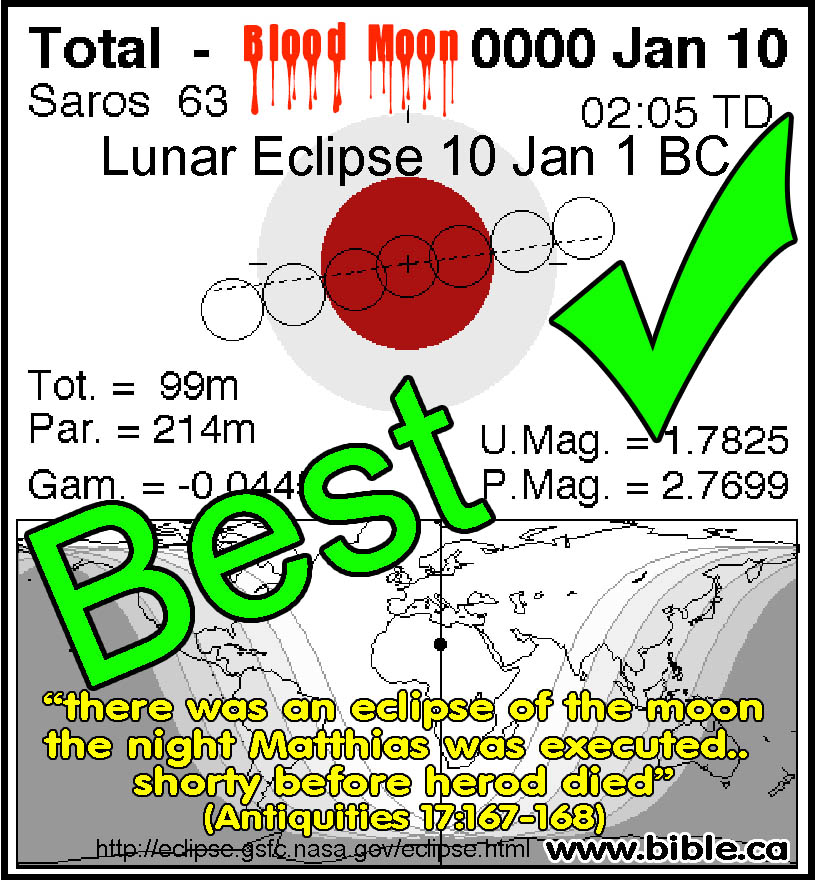
16. Lunar eclipse marking the slaughter of the children: 10 January 1 BC
a. Herod died shortly after the total lunar eclipse of Jan 10, 1 BC.
b. If Herod the Great died shortly after the total lunar eclipse of 10 January 1 BC, then Christ was born in 1-3 BC.
c. The birth of Christ in 2 BC favors Friday Nisan 14, 33 AD as the day Christ was crucified.
d. The approximate birth of Christ can be determined (2 BC) based upon the total lunar eclipse on 10 January 1 BC in conjunction with what Josephus said in Antiquities 17.167: "But Herod deprived this Matthias of the high priesthood, and burnt the other Matthias, who had raised the sedition, with his companions, alive. And that very night there was an eclipse of the moon. But now Herod’s distemper greatly increased upon him after a severe manner, and this by God’s judgment upon him for his sins: for a fire glowed in him slowly, which did not so much appear to the touch outwardly as it augmented his pains inwardly" (Antiquities 17.167-168)
e. This Eclipse would mark the slaughter of the children by Herod in addition to Matthias of the house of the High Priest.
f. The Magi who visited Jesus would surely notice the blood moon and directly associate it with Herod’s attempted slaughter of the king of the Jews. In 33 AD these same Magi would notice another eclipse where the second attempt to murder the Messiah was successful on the cross.
g. Here is the actual lunar eclipse chart from NASA:
i.
17. After the death of King Herod in 1 BC, Joseph returns to Nazareth with Mary and Jesus (Luke 2:39 & Matthew 2:19-23).
a. Jesus grows up in Nazareth.
18. There was another eclipse the night Jesus was crucified on 3 April 33 AD
a. At exactly 6:00 PM Nisan 14 the sun set in Jerusalem and at exactly the same time the moon rose in eclipse.
b. The lunar eclipse of 3 April 33 A.D. lasted 333 minutes and 66 degrees on the horizon.
c. The Magi would notice this eclipse marking the death of Christ and connect it with the eclipse in 10 Jan 1 BC that failed to kill Christ and marked the slaughter of the babies.
d. The same Magi who were attracted by the star at the time of the birth of Jesus would remember the lunar eclipse of 10 Jan 1 BC, 33 years earlier.
e. It would be stunning double marker where the first eclipse marked the failed attempt by Herod but the second eclipse marked the actual death of the King they gave gold frankincense and myrrh 33 to Jesus when we was born.
f.
Here is the actual Nasa chart of the lunar eclipse the
night Jesus was crucified:

III. The date of the birth of Christ is 2 BC not 6 BC:
A. There are a number of ways we can date the birth of Christ:
1. A careful examination of the timeline of when Herod the great began to reign.
a. Using 4 BC for the death of Herod actually creates a 3 year discrepancy in his chronology.
b. Rodger Young solves this three year discrepancy by dating the death of Herod to 1 BC. (see discussion below)
2. Two passages in Josephus give us specific details about when Herod died in 1 BC: Antiquities 17.149-181 and Antiquities 18.106.
3. We know that Jesus was born 6-12 months before the death of Herod the Great in 1 BC.
B. HEROD DIED IN 1BC: Three common mistakes are made in the Herodian timeline: (by Rodger Young, Chronological scholar, personal correspondence 2015 AD)
1. The date for the death of Herod the Great is 1BC not 4 BC.
a. According to Josephus, Herod reigned 37 years counting from his appointment by the Mark Antony and the Roman Senate, or 34 years counting from his conquest of Jerusalem. Josephus dates the first of these events in two ways: by the Roman consular date and by the Greek 184th Olympiad.
b. However, Appian's history (Civil Wars 5.8.75) places Herod's appointment in the next consular year, as does the history of Antony as recorded by Josephus himself.
c. Seeking to resolve these contradictory statements, we read that Josephus says elsewhere that the government of the Hashmoneans, which started in 162 BC, lasted 126 years until Antigonus was defeated by Herod in the conquest of Jerusalem.
d. Herod’s victory was thus in (162 – 126) = 36 BC, in exact agreement with another passage in Josephus that places Herod's taking of Jerusalem 27 years to the day after the city fell to Pompey, which was on the Day of Atonement, 63 BC. The 34 years from the capture of Jerusalem thus ended in 36 – 34 = 2, i.e. the regnal year that began in the fall of 2 BC and extended to the fall of 1 BC.
e. All of these figures work out exactly if Herod was appointed by the Romans in 39 BC, captured Jerusalem on the Day of Atonement in 36 BC, and died in early 1 BC, i.e. shortly after the total lunar eclipse of January 10, 1 BC.
f. None of these figures given by Josephus would be correct if Herod was appointed by the Romans in 40 BC, captured Jerusalem in 37 BC, and died in 5 or 4 BC, as maintained in the older, and now superseded, scholarship largely based on Emil Schürer's work over a hundred years ago.
2. In failing to realize that Herod’s successors, Archelaus, Antipas & Philip II were co-regent with Herod 3 years before he died which was 4 BC.
a. This explains why the first coins of Philip were dated “year 5”.
b. He started minting in the second year of his sole reign after Herod died.
c. In a strange co-incidence, the two errors have the effect of not changing the traditional dates for the END of their 3 reigns.
d. So they began to function as administrative assistant governors in 4 BC and as “Caesar certified” governors (Tetrarchs) in 1 BC after the death of Herod.
3. The 29 days between the partial lunar eclipse in 4 BC and Passover that year was insufficient time to accommodate all the events that Josephus describes related to the death of Herod, but there was sufficient time for them (89 days) between the full lunar eclipse of 10 January 1 BC and the Passover that year.
C. HEROD DIED IN 1BC: According to Josephus in Antiquities 17.149-181:
1. shortly after he killed 42 men who were led by Judas, son of Saripheus to down the golden eagle that Herod had set up in the Temple as a personal memorial.
2. shortly after a lunar eclipse that happened on January 10, 1 BC, the night that Herod killed the 42 men.
3. shortly after Herod appointed Joazar in place of Matthias as high priest.
4. Shortly after the slaughter of the children of Bethlehem, echoing Pharaoh’s slaughter of the babies at the time of Moses.
5. At the time he killed one man from each of the leading families in Israel echoing the 10th plague where the firstborn of every family died at the time of the Exodus.
6. Shortly BEFORE Passover.
7.
The lunar eclipse on 10 Jan 1 BC, therefore most likely marked Herod’s
slaughter of the children and the execution of the 42 rebels who tore down the
Silver eagle from the temple. It could also serve as a marker for the execution
of the leading men once Herod died.
a. Josephus is shockingly silent on the central story of the slaughter of the children when Herod had been tricked by the Magi
b. The Magi likely returned to Assyria by taking the route south of the salt sea at Wadi Zered, possibly passing through Petra (Kadesh Barnea).
c. The timing of Herod’s slaughter of the children would be no more than 30 days after they visited Jesus in the same house he had been born in months earlier. Now he was living on the second floor instead of the main floor stable of the house.
d. Since Bethlehem is only 6 km south of Jerusalem (half day journey) Herod would know for certain after a maximum of 30 days that he had been tricked by them.
e. This triggered Herod’s slaughter of the innocents 2 years and younger. This indicates that Jesus would be less than 1 year old because Herod would certainly leave a generous margin of “age error” giving us the birth of Jesus about a 1 year or less, before Herod died.
8. FULL TEXT OF JOSEPHUS Antiquities 17.149-181: “There was one Judas, the son of Saripheus, and Matthias, the son of Margalothus, two of the most eloquent men among the Jews, and the most celebrated interpreters of the Jewish laws, and men well-beloved by the people, because of their education of their youth; for all those that were studious of virtue frequented their lectures every day. (150) These men, when they found that the king’s distemper was incurable, excited the young men that they would pull down all those works which the king had erected contrary to the law of their fathers, and thereby obtain the rewards which the law will confer on them for such actions of piety; for that it was truly on account of Herod’s rashness in making such things as the law had forbidden, that his other misfortunes, and this distemper also, which was so unusual among mankind, and with which he was now afflicted, came upon him: (151) for Herod had caused such things to be made, which were contrary to the law, of which he was accused by Judas and Matthias; for the king had erected over the great gate of the temple a large golden eagle, of great value, and had dedicated it to the temple. Now, the law forbids those that propose to live according to it, to erect images, or representations of any living creature. (152) So these wise men persuaded [their scholars] to pull down the golden eagle; alleging, that although they should incur any danger which might bring them to their deaths, the virtue of the action now proposed to them would appear much more advantageous to them than the pleasures of life; since they would die for the preservation and observation of the law of their fathers; since they would also acquire an everlasting fame and commendation; since they would be both commended by the present generation, and leave an example of life that would never be forgotten to posterity; (153) since that common calamity of dying cannot be avoided by our living so as to escape any such dangers: that therefore it is a right thing for those who are in love with a virtuous conduct, to wait for that fatal hour by such a behavior as may carry them out of the world with praise and honor; (154) and that this will alleviate death to such a degree, thus to come at it by the performance of brave actions, which bring us into danger of it; and at the same time to leave that reputation behind them to their children, and to all their relations, whether they be men or women, which will be of great advantage to them afterward. 3. (155) And with such discourses as this did these men excite the young men to this action; and a report being come to them that the king was dead, this was an addition to the wise men’s persuasions; so, in the very middle of the day they got upon the place, they pulled down the eagle, and cut it into pieces with axes, while a great number of people were in the temple. (156) And now the king’s captain, upon hearing what the undertaking was, and supposing it was a thing of a higher nature than it proved to be, came up thither, having a great band of soldiers with him, such as was sufficient to put a stop to the multitude of those who pulled down what was dedicated to God: so he fell upon them unexpectedly, and as they were upon this bold attempt, in a foolish presumption rather than a cautious circumspection, as is usual with the multitude, and while they were in disorder, and incautious of what was for their advantage,—(157) so he caught no fewer than forty of the young men, who had the courage to stay behind when the rest ran away, together with the authors of this bold attempt, Judas and Matthias, who thought it an ignominious thing to retire upon this approach, and led them to the king. (158) And when they were come to the king, and he had asked them if they had been so bold as to pull down what he had dedicated to God, “Yes (said they, what was contrived we contrived, and what hath been performed, we performed it; and that with such a virtuous courage as become men; for we have given our assistance to those things which were dedicated to the majesty of God, (159) and we have provided for what we have learned by hearing the law: and it ought not to be wondered at, if we esteem those laws which Moses had suggested to him, and were taught him by God, and which he wrote and left behind him, more worthy of observation than thy commands. Accordingly we will undergo death, and all sorts of punishments which thou canst inflict upon us, with pleasure, since we are conscious to ourselves that we shall die, not for any unrighteous actions, but for our love to religion.” (160) And thus they all said, and their courage was still equal to their profession, and equal to that with which they readily set about this undertaking. And when the king had ordered them to be bound, he sent them to Jericho, and called together the principal men among the Jews; (161) and when they were come, he made them assemble in the theatre, and because he could not himself stand, he lay upon a couch, and enumerated the many labors that he had long endured on their account, (162) and his building of the temple, and what a vast charge that was to him; while the Asamoneans, during the hundred and twenty-five years of their government, had not been able to perform any so great a work for the honor of God as that was: (163) that he had also adorned it with very valuable donations; on which account he hoped that he had left himself a memorial, and procured himself a reputation after his death. He then cried out, that these men had not abstained from affronting him, even in his lifetime, but that, in the very daytime, and in the sight of the multitude, they had abused him to that degree, as to fall upon what he had dedicated, and in that way of abuse, had pulled it down to the ground. They pretended, indeed, that they did it to affront him; but if anyone consider the thing truly, they will find that they were guilty of sacrilege against God therein. 4. (164) But the people, on account of Herod’s barbarous temper, and for fear he should be so cruel as to inflict punishment on them, said what was done, was done without approbation, and that it seemed to them that the actors might well be punished for what they had done. But as for Herod, he dealt more mildly with others [of the assembly]; but he deprived Matthias of the high priesthood, as in part an occasion of this action, and made Joazar, who was Matthias’s wife’s brother, high priest in his stead. (165) Now it happened, that during the time of the high priesthood of this Matthias, there was another person made high priest for a single day, that very day which the Jews observed as a fast. (166) The occasion was this:—This Matthias the high priest, on the night before that day when the fast was to be celebrated, seemed, in a dream, to have conversation with his wife; and because he could not officiate himself on that account, Joseph, the son of Ellemus, his kinsman, assisted him in that sacred office. (167) But Herod deprived this Matthias of the high priesthood, and burnt the other Matthias, who had raised the sedition, with his companions, alive. And that very night there was an eclipse of the moon. 5. (168) But now Herod’s distemper greatly increased upon him after a severe manner, and this by God’s judgment upon him for his sins: for a fire glowed in him slowly, which did not so much appear to the touch outwardly as it augmented his pains inwardly; (169) for it brought upon him a vehement appetite to eating, which he could not avoid to supply with one sort of food or other. His entrails were also exulcerated, and the chief violence of his pain lay on his colon; an aqueous and transparent liquor also settled itself about his feet, and a like matter afflicted him at the bottom of his belly. Nay, farther, his privy member was putrified, and produced worms; and when he sat upright he had a difficulty of breathing, which was very loathsome, on account of the stench of his breath, and the quickness of its returns; he had also convulsions in all parts of his body, which increased his strength to an insufferable degree. (170) It was said by those who pretended to divine, and who were endowed with wisdom to foretell such things, that God inflicted this punishment on the king on account of his great impiety; (171) yet was he still in hopes of recovering, though his afflictions seemed greater than anyone could bear. He also sent for physicians, and did not refuse to follow what they prescribed for his assistance; and went beyond the river Jordan, and bathed himself in warm baths that were at Calirrhoe, which, besides their other general virtues, were also fit to drink; which water runs into the lake called Asphaltitis. (172) And when the physicians once thought fit to have him bathed in a vessel full of oil, it was supposed that he was just dying; but, upon the lamentable cries of his domestics, he revived; and having no longer the least hopes of recovering, he gave order that every soldier should be paid fifty drachmae; (173) and he also gave a great deal to their commanders, and to his friends, and came again to Jericho, where he grew so choleric, that it brought him to do all things like a madman; and though he were near his death, he contrived the following wicked designs. (174) He commanded that all the principal men of the entire Jewish nation wheresoever they lived, should be called to him. Accordingly, there were a great number that came, because the whole nation was called, and all men heard of this call, and death was the penalty of such as should despise the epistles that were sent to call them. And now the king was in a wild rage against them all, the innocent as well as those that had afforded him ground for accusations; (175) and when they were come, he ordered them all to be shut up in the hippodrome, and sent for his sister Salome, and her husband Alexas, and spoke thus to them:—“I shall die in a little time, so great are my pains; which death ought to be cheerfully borne, and to be welcomed by all men; but what principally troubles me is this, that I shall die without being lamented, and without such mourning as men usually expect at a king’s death.” (176) For that he was not unacquainted with the temper of the Jews, that his death would be a thing very desirable, and exceedingly acceptable to them; because during his lifetime they were ready to revolt from him, and to abuse the donations he had dedicated to God: (177) that it therefore was their business to resolve to afford him some alleviation of his great sorrows on this occasion; for that, if they do not refuse him their consent in what he desires, he shall have a great mourning at his funeral, and such as never any king had before him; for then the whole nation would mourn from their very soul, which otherwise would be done in sport and mockery only. (178) He desired therefore that as soon as they see he hath given up the ghost, they shall place soldiers round the hippodrome, while they do not know that he is dead; and that they shall not declare his death to the multitude till this is done, but that they shall give orders to have those that are in custody shot with their darts; and that this slaughter of them all will cause that he shall not miss to rejoice on a double account; that as he is dying, they will make him secure that his will shall be executed in what he charges them to do; and that he shall have the honor of a memorable mourning at his funeral. (179) So he deplored his condition, with tears in his eyes, and obtested them by the kindness due from them, as of his kindred, and by the faith they owed to God, and begged of them that they would not hinder him of this honorable mourning at his funeral. So they promised him not to transgress his commands. 6. (180) Now anyone may easily discover the temper of this man’s mind, which not only took pleasure in doing what he had done formerly against his relations, out of the love of life, but by those commands of his which savored of no humanity, (181) since he took care, when he was departing out of this life, that the whole nation should be put into mourning, and indeed made desolate of their dearest kindred, when he gave order that one out of every family should be slain, although they had done nothing that was unjust, or against him, nor were they accused of any other crimes; while it is usual for those who have any regard to virtue, to lay aside their hatred at such a time, even with respect to those they justly esteemed their enemies. (Josephus, Antiquities 17.149-181)
D. HEROD DIED IN 1BC: According to Josephus in Antiquities 18.106:
|
All Josephus manuscripts before 1544 AD |
Josephus manuscripts after 1544 AD |
|
“About this time it was that Philip, Herod’s brother, departed this life, in the 22nd year of the reign of Tiberius, after he had been tetrarch of Trachonitis, and Gaulonitis, and of the nation of the Bataneans also, 32/35 years.” (Josephus, Antiquities 18.106, pre 1544 AD manuscripts) |
“About this time it was that Philip, Herod’s brother, departed this life, in the 20th year of the reign of Tiberius, after he had been tetrarch of Trachonitis, and Gaulonitis, and of the nation of the Bataneans also, 37 years.” (Josephus, Antiquities 18.106, post 1544 AD manuscripts) |
1. Current editions of Josephus from manuscripts after 1544 AD say in Antiquities 18.106 that Philip died in the 20th year of Caesar Tiberius and he reigned 37 years. Manuscripts before 1544 AD say Philip died in the 22nd year of Tiberius with a 32 or 35 year reign.
a. The 20th year of Caesar Tiberius is 34 AD
b. The 22th year of Caesar Tiberius is 36 AD
2. A central argument offered by scholars supporting 4 B.C. as the year of Herod's death focuses on the dating of his son Philip's reign. Modern editions of Josephus's Antiquities of the Jews unanimously state that Philip died in the twentieth year of Tiberius, that is, in A.D. 34, after ruling thirty-seven years. Therefore: AD 34-37 year reign = 4 BC for the beginning point of Philip’s reign, which implies the death of Herod the Great his father. Although this superficial logic appears concise and irrefutable there are some serious considerations that are overlooked.
a. It ignores the likely 3 year coregency that started in 4BC until Herod died in 1BC. Coregencies were very common and it is unscholarly to ignore the possibility.
b. It ignores the fact that manuscripts before 1544 AD of Josephus Antiquities 18.106 say Philip died in the 22nd year of Caesar Tiberius with a 37 year reign.
3. The variation in numbers in pre vs. post 1544 AD manuscripts of Josephus Ant. 18.106
a. “My visits to the British Library in April 1983 uncovered evidence that substantiates Filmer's thesis. Out of the forty-six early editions of Josephus's Antiquities published before 1700 that were examined, twenty-seven demonstrate the uncommon "twenty-second year of Tiberius." Of these twenty-seven texts, all but three were published prior to 1544, some dating back to the twelfth and thirteenth centuries. Of greatest importance, however, is the fact that, in the British Library, not a single edition published prior to 1544 was uncovered bearing the "twentieth year of Tiberius." In 1994 I conducted further research in the Library of Congress. Their collection offered further confirmation of these original findings. Five more editions supported the "twenty-second year." Among the others, none prior to 1544 recorded the "twentieth year." Timothy Barnes's articulate response to W. E. Filmer's thesis is hereby challenged—not by another theory—but instead by thirty-two editions of Josephus' Antiquities still extant in the British Library and the Library of Congress. The work of Filmer is vindicated—Herod did die in 1 B.C. The year 1544 emerged as the focal point of my investigations. In that year a Greek text of the Antiquities (BrLib C76g7) was published in Basel. No other printing in Greek characters dated prior to 1544 was in the library's possession. Conceivably, it was the first printed edition of the Antiquities in Greek. Committing the elaborate written characters of the language to print was a monumental task for the publishing world of the sixteenth century. Unfortunately, this Greek edition was destined to become the universally accepted standard by the highest echelons of the scholastic world even though its chronology of Philip and Herod was divergent to all previously recorded histories.” (Josephus Reexamined: Unraveling the Twenty-Second Year of Tiberius, David W. Beyer, Chronos, Kairos, Christos II: Chronological, Nativity, p86, 1998 AD)
b. “The effect of the "twenty-second year of Tiberius" dating is to push the death of Philip down to A.D. 36; A.D. 34 is no longer possible. Now if we allow for a full thirty-seven-year reign, 1 B.C. emerges as the death year of Herod. Nevertheless, it is highly unlikely Philip actually reigned for all of his thirty-seven years, despite numismatic evidence supporting a thirty-seventh year. Meyshan has demonstrated that "coins always record conditions de jure not de facto." At this point, I must reveal that the thirty-seven-year reign was never used before 1544. It was adopted simultaneously along with the "twentieth year of Tiberius" creating a synchronous double error—two errors in one. What may prove to be of great interest to everyone here is that the earliest manuscripts, from the twelfth through the fifteenth centuries, attest unanimously to a thirty-two-year tenure without exception. This new evidence places the de facto inception of Philip's reign in A.D. 4. Josephan scholar, Steve Mason, confirms that Philip was made tetrarch in A.D. 4.” (Josephus Reexamined: Unraveling the Twenty-Second Year of Tiberius, David W. Beyer, Chronos, Kairos, Christos II: Chronological, Nativity, p87, 1998 AD)
c. “The problem with the number 22 at Antiquities 18.106 is that it occurs only in the Latin pre 1544 AD manuscripts of Josephus. No Greek manuscript reads 22 before 1544 AD. I suspect the 32 year reign of Philip is also a Latin manuscript anomaly at Ant. 18.106, but I'd have to check that out. I'd recommend you look at the new English Josephus volumes when possible (Flavius Josephus: Translation and Commentary). Unfortunately the volume containing Ant 18 is not yet published--but it is due out this year. The only alternative is to check out the 19th century critical edition of Josephus by Niese.” (Andrew Steinman personal correspondence. Jan 1 2017)
d. The early editions of Antiquities in the British Library's possession have a chronology of their own that develops in five stages. (Chart modified from: Josephus Reexamined: Unraveling the Twenty-Second Year of Tiberius, David W. Beyer, Chronos, Kairos, Christos II: Chronological, Nativity, 1998 AD)
|
Stage |
Period of Publication |
Year from Tiberius |
Yrs Reigned |
British Library |
Library of Congress |
Total |
|
1 |
ca. 1150-1489 |
22 |
32 |
12 |
1 |
13 |
|
2 |
1470-1514 |
22 |
35 |
7 |
4 |
11 |
|
3 |
1513-1519 |
22 |
32/35 |
2 |
0 |
2 |
|
4 |
1534-1549 (+1608) |
22 |
32 |
6 |
0 |
6 |
|
5 |
1544-present |
20 |
37 |
19 |
4 |
23 |
|
- |
Totals |
- |
- |
46 |
9 |
55 |
4. Conclusions regarding Josephus Antiquities 18.106:
a. It may be impossible to ever determine the original numbers in the passage.
b. The pre 1544 AD manuscripts consistently have the 22nd year of Tiberius of the death of Philip, but some manuscripts list his reign as 32 years, while other record a 35 year reign.
c. If we take the modern, post 1544 AD manuscript numbers we arrive at 4 BC for the beginning of Philip II’s reign. With a three year coregency, this fits perfect with other data the Herod the Great died in 1 BC.
d. If we use the pre-1544 pre 1544 AD manuscript numbers we compute the beginning of Philip’s reign at 4 AD using 22nd year of Tiberius + 32 year reign OR 1 AD using the 22nd year of Tiberius + 35 year reign.
e. The best solution is to accept the current/modern editions of Josephus to compute the beginning of Philip’s reign at 4 BC with a 3 year coregency until Herod died in 1 BC.
E. Other factors in correcting dating Herod the Great’s death to 1 BC: (Portions of this are from: Josephus Reexamined: Unraveling the Twenty-Second Year of Tiberius, David W. Beyer, Chronos, Kairos, Christos II: Chronological, Nativity, 1998 AD)
1.
“The Lunar Eclipse: Out of the hundreds of eclipses visible in
Palestine during the years covered in his histories, Josephus referred to only
one. Now the lunar eclipse of 9-10 January 1 B.C. was total, whereas the March
4 B.C. lunar eclipse was partial with a magnitude of only 0.37.” (Beyer)
2. “The Missing War: Within two months of Herod's death, the Jewish people began a major revolt so serious that all three legions in Syria were required to subdue it. Two thousand rebels were crucified and 30,000 Jews sold into slavery. Archelaus was deposed and the kingdom abolished.
a. This war poses a major problem for 4 B.C. proponents because it is an established fact that Augustus was demobilizing the army from 7 to 2 B.C., a period of unprecedented peace.'
b. In other words, no significant military conflict appears on the radar screen of history in 4, 3, or 2 B.C.
c. E. L. Martin has shown that the rebellion against Archelaus was fought in 1 B.C.
d. Inscriptions uncovered in Greece in 1960 demonstrate that a major war was fought in the Middle East that very year, 1 B.c.
e. The Augustan era of peace from 7 to 2 B.C. is a major obstacle for proponents of Herod's 4 B.C. death.
f. Their imaginary 4 B.C. war is still missing in action from the pages of history. (Beyer)
3. “Antedating of reigns: E. J. Bickerman has demonstrated how usual it was for Hellenistic rulers to extend the length of their reigns, most often by antedating." The Herodian kingdom was, of course, a direct outgrowth of political Hellenism, and the Jews had commonly antedated their reigns even back to the biblical period. Numismatic evidence supports Bickerman's antedating thesis.
a. Case 1: Antipas, a successor of Herod the Great, lost his throne in A.D. 39. There is a coin of Antipas marked with the regnal year 45, extending his era back to 6 B.C. which is not considered possible.'
b. Case 2: It is an established fact that Herod Agrippa I, Herod's grandson, ruled Philip's former territory from A.D. 38 to 44 and yet he minted coins in his eighth and ninth years." He had been awarded that position over Palestine by Caligula in A.D. 37 but remained in Rome another year and one-half, returning in late autumn A.D. 38. He soon began minting coins reckoned from the time of his appointment. Meyshan states that "this is additional proof that coins always record conditions de jure not de facto.' Since even Herod the Great awarded himself three regnal years in the de jure manner, is it not reasonable to conclude his successors continued the practice and that the coins of Antipas and Agrippa I are genuine? Bickerman's support of antedating clearly demonstrates it is not a fringe hypothesis, but instead, belongs to the mainstream of current thought.” (Beyer)
4. Coregency: Acceptance of antedating paves the way for coregency. … Coregency was very common among the kings of Judah and Israel in the Bible. “Throughout all of history, if ever there were a monarchy in a state of major crisis, the Herodian dynasty was it. Herod had no blood ties to the people except through his wife whose sons he had murdered. The kingdom was in a state of perpetual turmoil, anticipating the moment of Herod's death, elimination of the pretenders, and restoration of the throne to the people. If ever there were a time in history for a ruler to institute coregency, this was it. Because it was a practice established by Augustus himself, it would be irrational to believe Herod would not resort to it in order to bolster the political fortunes of his dynasty. Augustus yearned for stability in this region. He, himself, may very well have recommended the coregency option to Herod. Because coregency was in accord with the customs of the time, the burden of proof lies with those who imagine Herod avoiding this logical, sane, conservative course. So is there any evidence for coregency in Josephus' histories? Of course there is, although it is fashionable for contemporary scholars to scoff at it as "rhetorical hyperbole."" It is highly inconsistent to rely on Josephus's dating of Philip's reign as one's pivotal argument in this debate and then discredit his lucid references to the coregencies of Herod's sons. Recalling the direct eyewitness account of Nicolas of Damascus, Josephus wrote that Antipater was "at least coruler with his father and no different from a king."' Again, according to Josephus, Herod testified to Varus about Antipater "to whom I have in a manner yielded up my royal authority while I am alive?' Later, Antipater replied to his father, "I was king already . . . you proclaimed me king in your lifetime."' (Beyer)
a. Josephus explicitly states that Antiper/Antipater was coregent with Herod the Great. Antiper was the oldest son of Herod who was coregent with Herod the Great until he was executed by Herod in 4BC. In 4 BC, Herod made his other three sons coregent with him until his death in 1 BC.
b. “The eldest son of Herod by his first wife Doris. After his marriage to Mariamne the Hasmonean, Herod sent Doris and Antipater away. But when Herod, being suspicious of Mariamne’s loyalty, ordered her execution in 29 B.C., tensions arose between him and her sons, Alexander and Aristobulus. In order to humble them Herod restored Antipater to court. Antipater now sought to annihilate Mariamne’s sons by circulating calumnies against them. Even after Herod sent Antipater to Rome as the apparent crown prince in 12/11 B.C., he continued to send back false reports against his brothers. Inflamed by these reports Herod took the case before V 1, p 148 Caesar, who, finding nothing of substance, effected a temporary reconciliation. But Herod continued in his suspicions and in the end Antipater and his allies gained their objective: Alexander and Aristobulus were executed on Herod’s orders and Antipater became joint ruler with his father in 7 B.C. Testimony later came to light exposing both Antipater’s seditious activity against his brothers and a plot to murder the aged Herod. Antipater was condemned to death and the sentence carried out five days before Herod’s own death in March/April, 4 B.C. [note: this follows the incorrect chronology of Herod’s death at 4 BC rather than the correct 1 BC, but the details are otherwise correct]” (ISBE, Antipater, 1979 AD)
c. “However, he [Antipater, died] governed the nation jointly with his father [Herod the great], being indeed no other than a king already; and he was for that very reason trusted, and the more firmly depended on, for which he ought himself to have been put to death, as appearing to have betrayed his brethren out of his concern for the preservation of Herod, and not rather out of his ill will to them, and before them to his father himself: and this was the accursed state he was in.” (Josephus, Antiquities 17.3)
d. “I confess to thee, O Varus, the great folly I was guilty of; for I provoked those sons of mine to act against me, and cut off their just expectations for the sake of Antipater; and indeed what kindness did I do to them, that could equal what I have done to Antipater! to whom I have in a manner, yielded up my royalty authority while I am alive, and whom I have openly named for the successor to my dominions in my testament, and given him a yearly revenue of his own of fifty talents, and supplied him with money to an extravagant degree out of my own revenue” (Josephus, Wars, 1.625)
e. “Upon Herod’s saying this, he was interrupted by the confusion he was in; but ordered Nicolaus, one of his friends, to produce the evidence against Antipater. But in the meantime Antipater lifted up his head (for he lay on the ground before his father’s feet) and cried out aloud, (630) “Thou, O father, hast made my apology for me; for how can I be a parricide, whom thou thyself confessest to have always had for thy guardian? Thou callest my filial affection prodigious lies and hypocrisy! how then could it be that I, who was so subtle in other matters, should here be so made as not to understand that it was not easy that he who committed so horrid a crime should be concealed from men, but impossible that he should be concealed from the Judge of Heaven, who sees all things, and is present everywhere? (631) or did not I know what end my brethren came to, on whom God inflicted so great a punishment for their evil designs against thee? And indeed what was there that could possibly provoke me against thee? Could the hope of being a king do it? I was a king already. Could I suspect hatred from thee? No: was I not beloved by thee? and what other fear could I have? Nay, by preserving thee safe, I was a terror to others. (632) Did I want money? No; for who was able to expend so much as myself? Indeed, father, had I been the most execrable of all mankind, and had I had the soul of the most execrable wild beast, must I not have been overcome with the benefits thou hadst bestowed upon me? whom, as thou thyself sayest, thou broughtest [into the palace]; whom thou didst prefer before so many of thy sons; whom thou madest a king in thine own lifetime, and by the vast magnitude of the other advantages thou bestowest on me, thou madest me an object of envy.” (Josephus, Wars 1.629-632)
F. Conclusion: Jesus was born in 3/2 BC and crucified on Friday 3 April 33 AD, on Nisan 14.
1. When all the evidence and additional factors are considered, it is clear that the generally accepted date for the death of Herod at 4 BC forcing a birth of Christ in 6 BC, is wrong.
2. Since Herod died in 1 BC, Jesus was born in 3/2 BC.
3. Jesus was crucified on Friday 3 April 33 AD, on Nisan 14.
a. With a date of Christ’s birth of 3/2 BC, it is impossible to have a crucifixion in 30 AD.
b. A crucifixion date of 30 AD is only possible with a 6 BC birth of Christ.
4. Setting the death of Herod in 1 BC corrects a well known 3 year contradiction in his life chronology.
IV. The Census of Quirinius in 3/2 BC: Lk 2:1-3
|
"Now in those days (about 3 BC) a decree went out from Caesar Augustus, that a census be taken of all the inhabited earth. This was the first census taken while Quirinius was governor of Syria. And everyone was on his way to register for the census, each to his own city. Joseph also went up from Galilee, from the city of Nazareth, to Judea, to the city of David which is called Bethlehem, because he was of the house and family of David, in order to register along with Mary, who was engaged to him, and was with child." (Luke 2:1-5)
|
|
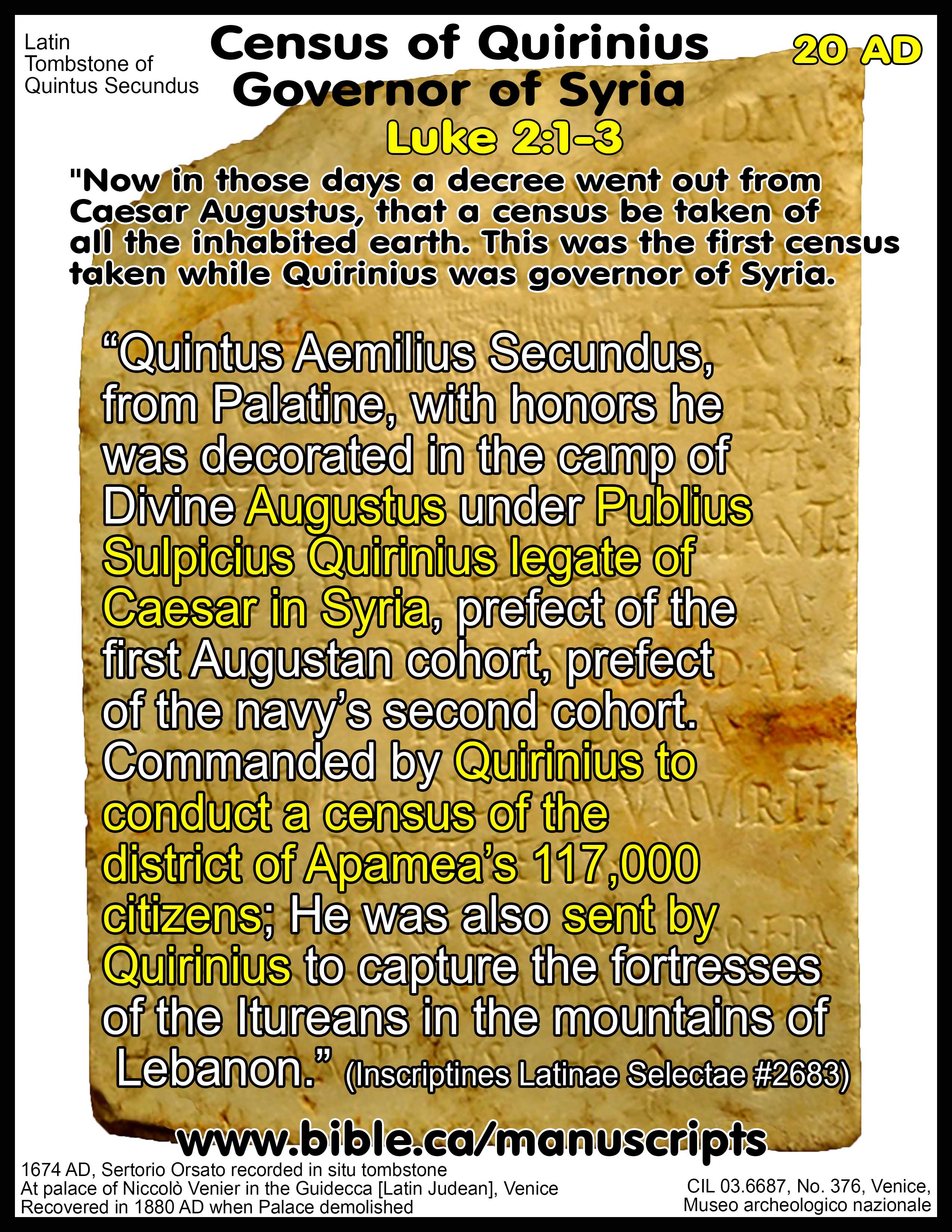
A. The tombstone of Quintus Aemilius Secundus that records the exact details of Luke 2:1-3
1. This tombstone is of a highly decorated Roman soldier who worked closely under Quirinius named: Quintus Aemilius Secundus:
a. Secundus had honors was decorated under Quirnius.
b. Secundus was prefect of the first Augustan cohort.
c. Secundus was prefect of the navy’s second cohort.
d. Secundus was commanded by Quirinius to conduct a census in Syria.
e. Secundus was sent by Quirinius to capture the fortresses of the Itureans.
2. The tombstone of Secundus likely dates to about 20 AD.
a. The province of the tombstone and inscription is solid: In 1674 AD, Sertorio Orsato recorded the in situ tombstone in the graveyard at palace of Niccolò Venier in the Guidecca [Latin Judean], Venice. Then the tombstone was lost, although the inscription was known. Then the tombstone was recovered in 1880 AD when the palace was demolished.
b. The Tombstone is currently part of the “Museo Archeologico Nazionale” Museum collection in Venice with museum registration numbers of: CIL 03.6687, No. 376.
c. The actual tombstone inscription translated from Latin: “Quintus Aemilius Secundus, from Palatine, with honors he was decorated in the camp of Divine Augustus under Publius Sulpicius Quirinius legate of Caesar in Syria, prefect of the first Augustan cohort, prefect of the navy’s second cohort. Commanded by Quirinius to conduct a census of the district of Apamea’s 117,000 citizens; He was also sent by Quirinius to capture the fortresses of the Itureans in the mountains of Lebanon” (Inscriptines Latinae Selectae #2683)
3. The inscription records these four details that exactly confirm Luke 2:1-3:
a. Names: Caesar “Augustus”
b. Three times the inscription names: “Publius Sulpicius Quirinius”
c. Names Quirinius as governor of Syria: “legate of Caesar in Syria”
d. Mentions Quirinius took a census in Syria: “conduct a census of the district of Apamea’s 117,000 citizens”
A. Who do you trust: The inspired apostle Luke or uninspired Josephus who was rebel Jew who rejected Jesus?
1. Confused Josephus indicates in one passage that the Quirinius Census took place in 6 AD.
2. This contradicts Luke who said the census took place before the birth of Christ (3/2 BC) around 3 BC.
3. I find it shocking that even Bible commentaries will side with Josephus and throw Apostle Luke under the buss saying, “Luke got it wrong, Josephus got it right.”
4. As you will see below, it is Josephus who was confused and we can prove it.
5. Shame on those who trash the reliability of the history recorded in the Bible.
B. Roger Young writes: “It was mentioned that in Ant. 18:2:1/26-28, Josephus stated that Quirinius came to Syria in the 37th year of Octavius's victory at Actium, i.e. in AD 6. In other passages in Antiquities and in the Jewish Wars, Josephus associates several events with the census associated with the name of Quirinius. Among these are an uprising against the census and its taxation led by a certain Judas and the appointment and then removal of Joazar as high priest. Rhoads follows Schwarz, Lodder, and others in a literary analysis that demonstrates that Josephus, in these writings, used different sources, and either these sources did not agree among themselves, or Josephus misplaced them chronologically. Here are some of the problems encountered when trying to reconcile the various passages relating to the census:
- In Ant. 17:6:2-3/149-163, Judas, son of Saripheus (or the Sepphorean=person from Sepphoris in Galilee), a celebrated interpreter of the Jewish law, gathers a group of young disciples and encourages them to die in a noble cause. They tear down the golden eagle that Herod had set up in the Temple. Herod then executes Judas and his followers.
- In Ant. 17:10:5/271-272, Judas, from Sepphoris in Galilee, raises an insurrection during the last days of Herod.
- In Ant. 18:1:1-2:1/4-23 and Wars 2:8:1/117-118, Judas the Galilean, a celebrated teacher of one of the four sects of the Jews, taught his followers to be willing to die for a noble cause. He leads an insurrection against the Roman taxation. This at the time that Quirinius came to Syria, which in this passage Josephus dates to the 37th year of Octavius's victory over Mark Anthony at Actium, i.e. to AD 6.”
C. Rodger Young continues: “Rhoads shows that all three passages refer to the same Judas and the insurrection he led (see a mention of this Judas in Acts 5:37). If this is true, then Josephus has made a mistake in one or more of the passages. Either the revolt was in the last days of Herod (so passages 1 and 2), or it was in AD 6 (so passage 3). That it is the third passage that has the wrong date is shown by a consideration of the high priest Joazar, whose appointment and deposition are closely associated with events related to the insurrection under Judas the Galilean in the last days of Herod the Great.
- In Ant. 17:6:4/167, Herod, only a few weeks before his death, installed Joazar as high priest in place of Matthias, because Joazar had persuaded the people to accept the Roman taxation.
- In Ant. 17:13:1/339-341, Josephus relates that when Archelaus succeeded Herod, he removed Joazar from office. Not long after, Archelaus removed Eleazar and installed a certain Jeshua, son of Sie.
- In Ant. 18:2:1/26, apparently derived from a different source, it is Quirinius, supposedly in AD 6, who deprived Joazar of the priesthood. Ascribing this act to both Quirinius, and at the same time to either Herod or Archelaus who acted under his authority, would be reasonable if Quirinius came to Judea just before the death of Herod. What is not reasonable, however, is the idea that Joazar was high priest in AD 6. Joazar's dismissal by Quirinius and/or Archelaus places the coming of Quirinius, and the taxation, in 4 or 3 BC.”
D. Rodger Young concludes: “Josephus's dating of the coming of Quirinius to AD 6 therefore contradicts information he had supplied elsewhere regarding the last days of Herod and the tax that was instrumental in provoking the revolt of Judas the Galilean. All of these events--the enrollment, the taxation, Judas's revolt, the deposition of Joazar, and the coming of Quirinius--took place in the timeframe of about 4 BC to early 2 BC, in agreement with Luke's statement that the cause for Joseph and Mary coming to Bethlehem was an enrollment in the days when Quirinius exercised authority over (hegemoneuontos) Syria and Judea. There is much more that could be said. Fortunately it is said, in Rhoads' presentation.”
V. No room in the Inn or a private house? Lk 2:7

1. Word study of three important Greek words:
|
Passage |
Kataluma "Guest room" |
Pandocheion Public Inn, Hotel |
huperōͅon Upper room |
|
Meaning of Greek word |
Literally: "loosen down" metaphoric of loosening clothing and sandals |
Literally: "all receiving" anyone with money is welcome to stay |
Literally: "upper", as in the upper room of a private dwelling |
|
No room for Jesus in the Guest room? Lk 2:7 |
|
|
|
|
Prepare Passover in upper room Lk 22:11, Mk 14:14 |
|
|
|
|
Parable of the Good Samaritan who stated in an inn with innkeeper Luke 10:34-35 |
|
|
|
|
The twelve gathers in upper room waiting for Pentecost: Acts 1:13 |
|
|
|
|
Tabitha laid in upper room: Acts 9:36-37 |
|
|
|
|
Only recorded church service is in an upper room: Acts 20:8 |
|
|
|

2. Notice Jesus began and ended his life in "the guest room", not an inn:
a. Jesus' first night on earth there was no room in the guest room: “And she gave birth to her firstborn son; and she wrapped Him in cloths, and laid Him in a manger, because there was no room [τόπος/topos] for them in the inn [κατάλυμα/kataluma] (Luke 2:7)
b. Jesus' last night on earth was in the guest room: “And you shall say to the owner of the house, ‘The Teacher says to you, “Where is the guest room in which I may eat the Passover with My disciples?” (Luke 22:11)
c. The word translated "inn" in most Bibles in Lk 2:7, literally means to "loosen down" and is metaphoric of loosening clothing, girdles, back packs, sandals, etc. and relaxing.
d. Some suggest that "loosen down" includes unpacking horses, mules and proves it was a public inn. The problem with this logic, is this: If there was no room for them in the room where the place animals would be unburdened and "loosened" of their packs, how did they end up in the very place the animals spent the night in the inn? Obviously therefore, there was no room in the place that humans would sleep "guest room" so they had no choice but to spend the night in the place the animals would normally sleep.
e. Is it possible that the second floor of homes had no separate guest rooms? Perhaps the entire living space was used by the family themselves. They generally did not have an area set aside for guests that had a little teddy bear on the bed and a chocolate under the pillow… just in case someone visited. These houses were tiny and it is a puzzle where guests would actually stay? Perhaps the "loosening down" room was the entire second floor of the house which is where guests would stay. In other words, the guests would stay in the same open area on the second floor as the family who lives there.
3. There are two key Greek words used in Luke 2:7: "τόπος/topos: no room" and "κατάλυμα/kataluma: the inn"
a. "Topos" does not mean a "hotel room" but simple the generic "space". There was "no place for them to stay" = "no room"
b. "Kataluma" does not necessarily mean a public hotel or inn, but a simple upper room. The word is used three times in the Bible and the other two times refers to the "upper room" where Jesus ate the Passover mean and instituted the Lord's supper the night he was arrested: “And you shall say to the owner of the house, ‘The Teacher says to you, “Where is the guest room in which I may eat the Passover with My disciples?” (Luke 22:11) see also Mark 14:14 for same word.
c. There is different Greek word (πανδοχεῖον/pandocheion) that specifically means a public in with an inn keeper used in the story of the good Samaritan: “and came to him and bandaged up his wounds, pouring oil and wine on them; and he put him on his own beast, and brought him to an inn [πανδοχεῖον/pandocheion] and took care of him. “On the next day he took out two denarii and gave them to the innkeeper and said, ‘Take care of him; and whatever more you spend, when I return I will repay you.’” (Luke 10:34-35)
4. The Upper Room in the book of Acts: huperōͅon, literally: Upper room. Why would Luke use two different words to describe the same area? In Luke, he uses kataluma (loosen down) in Acts he uses huperōͅon (upper room).
a. “When they had entered the city, they went up to the upper room [huperōͅon] where they were staying; that is, Peter and John and James and Andrew, Philip and Thomas, Bartholomew and Matthew, James the son of Alphaeus, and Simon the Zealot, and Judas the son of James.” (Acts 1:13)
b. “And it happened at that time that she fell sick and died; and when they had washed her body, they laid it in an upper room [huperōͅon]. Since Lydda was near Joppa, the disciples, having heard that Peter was there, sent two men to him, imploring him, “Do not delay in coming to us.” So Peter arose and went with them. When he arrived, they brought him into the upper room [huperōͅon]; and all the widows stood beside him, weeping and showing all the tunics and garments that Dorcas used to make while she was with them.” (Acts 9:37–39)
c. “On the first day of the week, when we were gathered together to break bread, Paul began talking to them, intending to leave the next day, and he prolonged his message until midnight. There were many lamps in the upper room [huperōͅon] where we were gathered together.” (Acts 20:7–8)
5. Many commentators say Jesus was born in a private residence:
a. "I believe it means a room in a private house in which travelers could usually spend the night." (Hermeneia Commentary, Luke 2:7)
b. "On this reading it is best to think of an overcrowded Palestinian peasant home: a single-roomed home with an animal stall under the same roof (frequently to be distinguished from the family living-quarters only by the raised platform floor of the latter). The manger could be free-standing in the stall or attached to the wall (it could also be on the floor of the living area adjacent to the stall area, but this would not fit with the exclusion of the child from the living quarters), κατάλυμα will, then, refer to the living quarters provided by a single-roomed Palestinian home in which hospitality has been extended to Mary and Joseph." (World Biblical Commentary, Luke 2:7)
c. "κατάλυμα, ‘lodging’, can be used of a guest-room (22:11; Mk. 14:14), so that the reference may be to a room rather than to an inn (πανδοχεῖον, 10:34), and to a room in a private house rather than to a room in an inn" (New International Greek Testament Commentary, Lk 2:7)
d. "And so they found a κατάλυμα or “stopping place,” surely with some relative of Joseph’s in the town. The house was small and perhaps had only one or two rooms and a shed for an animal or two. The only accommodation that could be offered to Joseph and to Mary was this shed. Here they slept, and when the time came, the baby was born here with only a manger in which to sleep. This manger may have been located on the stable floor. Joseph’s ass may have been tied here with any other animal that belonged to the house-owner. The shed would be roomy enough. This description adheres closely to all that Luke indicates. Besides, it utilizes what the author saw in the Holy Land, for instance, the house of one of the guides that was built of heavy stones (like all houses in Palestine) and had two rooms and a stone side room. It was entered only from the outside and was partly filled with a small heap of alfalfa and wheat." (Lenski, Luke 2:7)
e. "Because there was no room for them in the inn: This does not refer to a lack of a “hotel room” but lack of a suitable “place” for Mary to give birth to her son. It does not imply any rejection on the part of the much maligned innkeeper. The “inn” probably refers to a public caravansary (a crude overnight lodging place for caravans), which was the one lodging place in Bethlehem." (The New American Commentary, Lk 2:7)
f. "laid him in a manger. I.e. in a feeding trough for domesticated animals (see MM, 665). It could have been in a barn or in some feeding-place under the open sky, as the contrast with “lodge” in the rest of the verse would suggest. However, the word phatnē can also mean a “stall, feeding-place” (see H. J. Cadbury, JBL 45 [1926] 317–319; 53 [1933] 61–62), i.e. an enclosure where animals might be penned, either indoors or outdoors (see Luke 13:15). The verb aneklinen seems to the call for the meaning, “manger.” No mention is made of animals in this text. Their presence in the Christmas cribs of later date is derived from Isa 1:3. The tradition of Jesus’ birth in a “cave” is derived from the Prot. Jas. 18.1; it is also found in Justin Dial. 78, and Origen Contra Celsum 1.51. no room. I.e. no space (topos). The implication is that Mary and Joseph were not the only ones who have come to the town of David for the registration so that there was simply not space enough for all. in the lodge. In Luke 22:11 katalyma occurs again, to denote the “guestroom” where Jesus and his disciples eat the Last Supper. From the use there and here it is rather obvious that it does not mean an “inn”; furthermore, Luke uses the word pandocheion for that in 10:34. Actually, katalyma, a compound of kata + lyein, “loose,” denotes a place where one “lets down” one’s harness (or baggage) for the night. Cf. Luke 9:12; 19:7. In 1 Sam 1:18 Elkanah and Hannah on their visit to the sanctuary of Shiloh stay in a katalyma (LXX), which may have influenced Luke’s expression here. It should be understood as a public caravansary or khan, where groups of travelers would spend the night under one roof." (Anchor Yale Bible commentary, Fitzmyer, J. A., Luke 2:7, 2008 AD)
VI. The four room house in ancient Israel:
1. Archeologically, it is well documented that the "middle class" house in ancient Israel was a two story building with four rooms on the main floor.
2. The upper room, also called guest room may have taken up the entire second floor area, less the open air section. It may have the same floor plan as the main floor, or perhaps it had an open air roof area on one or both sides (as pictured below)
3. On the main floor there were four rooms
a. Room 1: A central open air working area.
b. Room 2: A rear storage area for food that ran the full width of the house.
c. Room 3: A manger and stable for domestic animals (this is where Jesus was born)
d. Room 4: a general use room
4. A cistern for water accessible from one of the four main floor rooms
VII. Where did the star lead the wise men (Magi): Bethlehem or Nazareth?
1. The tradition that the star shone over the manger of Jesus the night he was born and that the wise men were there that night is completely wrong.
2. The Magi left Persia or Babylon (700 km trip) only after they saw the star.
a. Herod determined to execute all children in Bethlehem under the age of two years old.
b. Given the error margin, this would put Jesus anywhere from newborn to about 6 months old when the Magi arrived, given the travel time of no less than 30 days.
3. The flight to Egypt did not happen until after Jesus had been circumcised on the 8th day and Mary had offered a sacrifice for her own purification on the 33rd day.
a. “Speak to the sons of Israel, saying: ‘When a woman gives birth and bears a male child, then she shall be unclean for seven days, as in the days of her menstruation she shall be unclean. ‘On the eighth day the flesh of his foreskin shall be circumcised. ‘Then she shall remain in the blood of her purification for thirty-three days; she shall not touch any consecrated thing, nor enter the sanctuary until the days of her purification are completed. ‘But if she bears a female child, then she shall be unclean for two weeks, as in her menstruation; and she shall remain in the blood of her purification for sixty-six days. ‘When the days of her purification are completed, for a son or for a daughter, she shall bring to the priest at the doorway of the tent of meeting a one year old lamb for a burnt offering and a young pigeon or a turtledove for a sin offering. ‘Then he shall offer it before the LORD and make atonement for her, and she shall be cleansed from the flow of her blood. This is the law for her who bears a child, whether a male or a female. ‘But if she cannot afford a lamb, then she shall take two turtledoves or two young pigeons, the one for a burnt offering and the other for a sin offering; and the priest shall make atonement for her, and she will be clean.’ ”” (Leviticus 12:2–8)
b. “And when eight days had passed, before His circumcision, His name was then called Jesus, the name given by the angel before He was conceived in the womb. And when the days for their purification according to the law of Moses were completed, they brought Him up to Jerusalem to present Him to the Lord (as it is written in the Law of the Lord, “Every firstborn male that opens the womb shall be called holy to the Lord”), and to offer a sacrifice according to what was said in the Law of the Lord, “A pair of turtledoves or two young pigeons.”” (Luke 2:21–24)
c. Notice that the offering of two turtledoves/pigeons was for the mother after 33 days!
d. The flight to Egypt did not happen before 33 days after Jesus was born.
e. However, during this 33 day period, it is likely that Mary, Joseph and Jesus were either living in the same house he was born in, or in another house in Bethlehem.
f. It says that Mary, "they brought Him up to Jerusalem to present Him to the Lord", with proves they were not staying in Jerusalem, but most likely Bethlehem during the 33 days of purification.
g. After the 33rd day, they departed for Nazareth. But was this immediately after the purification or after the flight to Egypt? “When they had performed everything according to the Law of the Lord, they returned to Galilee, to their own city of Nazareth.” (Luke 2:39)
4. The Magi arrive in Jerusalem likely on about day 40:
a. The Magi did not arrive in Jerusalem before 33 days after Jesus was born since Mary purified herself according to the law.
b. They come to Jerusalem because the star indicated it was the king of the Jews and Jerusalem was the capital.
c. They did not know where Jesus was born in Israel based upon the star, but had to consult religious leaders who quoted Micah 5:2. It is therefore important to understand that the star did not give them any information up to this point, as to where Jesus was located.
d. Herod sends the Magi to Bethlehem and after they had begun the 10 km journey and left the presence of Herod, they are then guided miraculously by the star to the exact house where Jesus is living.
5. The star led them to the HOUSE where Jesus was living. Was this house in Bethlehem or Nazareth?
a. We know that Jesus was not born in the barn of an inn, but the main floor of a house of their relatives.
b. So if Jesus was in Bethlehem when the Magi arrived on day 45 after Jesus' birth, then it is likely that Jesus is staying in the same house that he was born in… but staying in the upper room, not on the main floor.
c. However, Luke 2:39 says that they departed for Nazareth after the 33rd day: “When they had performed everything according to the Law of the Lord, they returned to Galilee, to their own city of Nazareth.”
6. Harmonizing the Matthew and Luke accounts of the birth of Jesus:
|
|
Purification |
Go home to Nazareth on day 34 |
Flight to Egypt |
Return to Judah, then Nazareth after flight to Egypt |
|
Matthew 2 |
No |
No |
Yes |
Yes |
|
Luke 2 |
Yes |
Yes |
No |
No |
|
Harmony #1 |
Yes |
Yes |
Yes from Nazareth |
Yes |
|
Harmony #2 |
Yes |
No |
Yes from Bethlehem |
Yes |
a. Please take note of this difference between Matthew and Luke:
i. Matthew has the flight to Egypt but not the 33rd day purification.
ii. Luke has the 33rd day purification but not the flight to Egypt.
b. How shall we harmonize the two accounts to arrive at the correct sequence of events when Luke 2:39 says they left for Nazareth after the 33 days of purification?
i. Interpretation #1: Purification, move to Nazareth, flight to Egypt, return to Judah, return to Nazareth.
ii. Interpretation #2: Purification, flight to Egypt return to Judah, return to Nazareth
c. While it is clear that Jesus was staying with relatives in Bethlehem until the 33 days were complete, it is natural to expect them to return to their house in Nazareth immediately after.
d. However, it is also possible that the Magi arrived shortly after the 33 days and visited the house in Bethlehem.
7. Arguments that support the idea that the Magi were led by the star to homestead "house" of Joseph and Mary in Nazareth where they had already lived for some time:
a. As soon as the Magi left Jerusalem the star would shine 180 degrees the opposite direction of Bethlehem. They would be led north of Jerusalem to Nazareth, not south to Bethlehem. This fact would not be learned by Herod, who wrongly assumed that Jesus was in Bethlehem and order the slaughter of all the children.
b. The bible does not say that the Magi were ever in Bethlehem. In fact the Bible does not tell us where the Magi were when they visited Jesus.
c. If Jesus was still in Bethlehem when the Magi left Herod for Bethlehem, this was a very dangerous place for God to have Jesus living in. Remember that Herod killed the babies not only in Jerusalem, but in the entire surrounding area. But if Jesus is 120 km north at Nazareth, he would be completely outside the area of the initial slaughter by Herod. There was a risk that Herod could have followed the Magi to the house in Bethlehem and immediately killed Jesus. If the flight from Bethlehem, they needed to also escape the surrounding area. This is quite dangerous.
d. Luke 2:39 says: “When they had performed everything according to the Law of the Lord (on day 33), they returned to Galilee, to their own city of Nazareth.”
e. Mary and Joseph would want to return to their home in Nazareth where they came from.
f. It might have been important for the baby Jesus to make an appearance to all their friends and family in Nazareth as a way to confirm he was indeed a natural Nazarene as per prophecy. If the flight to Egypt happened from Bethlehem, then the first time the people of Nazareth saw Jesus was at age 4-6 years old. This might affect his status as growing up as a resident of Nazareth. But if Mary travels back to Nazareth for a few weeks and "shows off her newborn", then fled to Egypt, Jesus would have a firm claim of being a Nazarene before he arrived after returning to Nazareth and the flight to Egypt.
g. The flight to Egypt would be necessary because, although Herod's first slaughter was in Bethlehem, he would eventually learn the wise men had been in Nazareth. However there is no indication that Herod ever initiated any slaughter around Nazareth.
8. Arguments that support the idea that the Magi were led by the star to the birth "house" in Bethlehem:
a. Although we are not told that the Magi ever went to Bethlehem, there is no indication in the narrative that the Magi went to Nazareth either.
b. The natural reading of the text has the Magi leaving Herod for Bethlehem, and then being led by the star to the Baby. If they had such a significant change of plans by rerouting from their original intention of Bethlehem to Nazareth, we would expect some comment about this from Matthew.
c. After the Magi left the baby Jesus, Herod initiated a slaughter in Bethlehem, not Nazareth. It is likely that Herod would have people following
d. There is some urgency in the angel's command to leave, AS SOON as the Magi had left. They did leave in a rush that very night: “Now when they had gone, behold, an angel of the Lord appeared to Joseph in a dream and said, “Get up! Take the Child and His mother and flee to Egypt, and remain there until I tell you; for Herod is going to search for the Child to destroy Him.” So Joseph got up and took the Child and His mother while it was still night, and left for Egypt.” (Matthew 2:13–14)
e. If the baby was in Nazareth, such urgency would be puzzling, given they are 120 km north of Jerusalem.
f. A flight from Bethlehem to Egypt is away from Jerusalem. A flight from Nazareth, would require Jesus to pass by Jerusalem and the area of Bethlehem on route to Egypt.
g. The Magi returned a "different route" from which they had come. This indicates that Jerusalem, the arrival city, was also their departure city. They would travel from Bethlehem through Jerusalem then back the route they came. If they departed from Nazareth, they would already be 120 km north of Jerusalem and have no need to avoid Jerusalem. It clearly indicates that the change in route was an effort to avoid Herod in Jerusalem. However, it may have been known the standard route they would travel even if they were departing from Nazareth, and for this reason took an entirely new route back to Persia or Babylon.
h. Herod would eventually learn where the Magi had been and there is no indication that he initiated a slaughter in Nazareth, which he would have done, after being tricked by the Magi. First he would initiate a slaughter in Bethlehem, and later, when he learned the Magi were in Nazareth, he would have surely killed the children in Nazareth as well. But there is only one slaughter and that was in Bethlehem.
i. The traditional view is that the Magi visited in Bethlehem… even if it is wrong about the visit taking place the night Jesus was born. There is no tradition we are aware of, that the Magi visited Jesus in Nazareth.
9. Conclusion:
a. The star could have shone over Bethlehem or Nazareth.
b. Both scenarios are supported in scripture and either are possible.
c. Perhaps the two key details are the urgent flight of Mary and Joseph the night the Magi left coupled with the fact the Magi took an alternate route to avoid Herod. These two details lend support to the idea that the Magi visited Bethlehem.
d. If so, there was a star of Bethlehem, but the Magi did not arrive until after 33 days the birth of Jesus. The star the Magi saw from a distance in Babylon AND the star that led them to the house was not something the average person would notice.
e. The Magi visited a house, not a barn, not an inn. If the star shone over Bethlehem, then scripture explicitly confirms the fact that first century houses had living quarters on the second floor and a place for animals on the first floor and that Jesus was born in a typical first century houses on the main floor and laid in a manger. The Magi visited a HOUSE, probably the same house where there was no space for them to sleep in the upper room, so they bedded down beside the animals.
VIII. What is the date of Jesus' Birthday?
1. There is virtual agreement among scholars that December 25 is not the birth date, not even the month that Jesus was born. The earliest trace of a celebration of Christ's birthday dates back to about 250 AD, when a date in the spring was celebrated by some Christians.
2. The exact date of Jesus' birth is a mystery because God did not think it was an important date to know. About the best we can do is to possibly narrow it down to seasons.
3. The Bible does give us some clues. The shepherds were in the fields with their flocks at night when Jesus was born. This may indicate that Jesus was born during the warmer seasons. During the coldest months like December or January, the shepherds didn't sleep in the fields but would bring their flocks into corals.
a. "Flocks were kept outside in this way from April to November (SB II, 114–116) and occasionally in suitable locations during the winter (cf. Morris, 84)" (New International Greek Testament Commentary, Lk 2:8)
b. "Out in the fields. Shepherds were out in the fields with their flocks usually during the months of March to November. Nothing in the two birth accounts ties Jesus’ birth to any specific date." (New American Commentary, Lk 2:8)
c. "abiding in the fields—staying there, probably in huts or tents. watch … by night—or, night watches, taking their turn of watching. From about passover time in April until autumn, the flocks pastured constantly in the open fields, the shepherds lodging there all that time. (From this it seems plain that the period of the year usually assigned to our Lord’s birth is too late)." (JFB Commentary, Lk 2:8)
4. However some reject this reasoning and maintain that the shepherds and flocks stayed in the fields year round.
a. "The place [birth place] shown to tourists should deceive no one. So also the deduction that Jesus could not have been born in December, which is fortified by Talmudic notices to the effect that some time between April and November must be referred to. This conclusion is valueless, for in a climate such as Palestine has sheep could be kept out-of-doors all winter. While December 25 is only traditional and goes back to the celebration of the nativity at Rome on that date in the fourth century, it is at least traditional and better than deductions that have no basis and only assail the old date without furnishing even the inkling of a new one. Only one conclusion is sound, namely that Jesus was born at night—otherwise the angel would not have appeared to the shepherds “at night.” (Lenski, Lk 2:8)
5. Was Jesus born during the lambing period?
a. There is a tradition that Bethlehem was in fact, the very town where the Jerusalem Passover lambs were born and raised. This is quite credible, considering the fact that David (through inspiration) created a whole new spiritual system with the temple in Jerusalem that Solomon built. David was also a shepherd and given he was king, would logically chose his birth town, the "city of David" (Bethlehem) to be the place that raised such important lambs for the annual day of atonement on Nissan 14, when the High Priest would take the blood and sprinkle it on the Ark of the Covenant. If this is true, then it is possible that Jesus was born in the very manger where the actual Passover lambs were born.
b. The "lambing season" for sheep is in February in Israel. It is an interesting suggestion that Jesus, being the "lamb of the world" was born at exactly the same time the literal lambs were born. If so then Jesus was born when the lambs were born and he died when the Passover lamb was slaughtered on Nissan 14.
c. But as we pass from the sacred gloom of the cave out into the night, its sky all aglow with starry brightness, its loneliness is peopled, and its silence made vocal from heaven. There is nothing now to conceal, but much to reveal, though the manner of it would seem strangely incongruous to Jewish thinking. And yet Jewish tradition may here prove both illustrative and helpful. That the Messiah was to be born in Bethlehem, was a settled conviction. Equally so was the belief, that He was to be revealed from Migdal Eder, ‘the tower of the flock.’ This Migdal Eder was not the watch-tower for the ordinary flocks which pastured on the barren sheep-ground beyond Bethlehem, but lay close to the town, on the road to Jerusalem. A passage in the Mishnah leads to the conclusion, that the flocks, which pastured there, were destined for Temple-sacrifices,2 and, accordingly, that the shepherds, who watched over them, were V 1, p 187 not ordinary shepherds. The latter were under the ban of Rabbinism, on account of their necessary isolation from religious ordinances, and their manner of life, which rendered strict legal observance unlikely, if not absolutely impossible. The same Mishnic passage also leads us to infer, that these flocks lay out all the year round, since they are spoken of as in the fields thirty days before the Passover—that is, in the month of February, when in Palestine the average rainfall is nearly greatest. Thus, Jewish tradition in some dim manner apprehended the first revelation of the Messiah from that Migdal Eder, where shepherds watched the Temple-flocks all the year round. Of the deep symbolic significance of such a coincidence, it is needless to speak. (The Life and Times of Jesus The Messiah, Afred Edersheim, p186-187)
6. Another indication of the time of year Jesus was born, is that the census that Caesar Augustus took in Luke 2:1, would not have been done during the coldest harshest season.
a. Such a census would require mass migration of large numbers of the population.
b. Unless Augustus deliberately wanted to make life difficult, he would take such a census during the warmer months and certainly not in December
“Now the birth of Jesus Christ was as follows: when His mother Mary had been betrothed [ketubah] to Joseph, before they came together she was found to be with child by the Holy Spirit. And Joseph her husband, being a righteous man and not wanting to disgrace her, planned to divorce her away secretly.” (Matthew 1:18–19)
- There were three states of a marriage in the Bible: (Click here for a detailed study of the Three Stages of ancient Jewish Marriage)
- Stage 1: signing the "ketubbah" contract (Creating the marriage bond)
i. The bride would chose her husband and her father would sign a legal contract with him called a "ketubbah".
ii. Once this is signed the couple is 100% married but do not have sex yet.
- Stage 2: The "chuppah": sexual consummation.
i. Up to 7 years later, the groom is able to raise the money as set out in the ketubbah contract and notifies the father of the bride, who then sets a date to consummate the marriage at the bride's home.
ii. The bride waits with her maidens, for the arrival of the groom and his companions.
iii. The couple enters the chuppah room and consummates the marriage while the companions of the bride and groom wait and celebrate outside or in the next room.
iv. The groom hands the bloodied "proof of virginity cloth" to the witnesses chosen by the bride's parents, who then give it to the bride for safekeeping.
- Stage 3: The wedding feast
i. After consummation, the entire wedding party walks to the house of the groom in a procession for a wedding feast.
ii. At the conclusion of the wedding feast, the couple has completed the ancient ritual of marriage.
- Joseph and the father of Mary had signed a ketubah and were 100 % married:
- The Holy Spirit calls Joseph "her husband" before they had "come together" (she was a virgin)
- Joseph was going to divorce her.
- Mary was in a vulnerable position at the mercy of her husband: She was pregnant before the chuppah (formal stage two consummation ceremony) and had no "virginity cloth".
- “Mary said to the angel, “How can this be, since I am a virgin?” The angel answered and said to her, “The Holy Spirit will come upon you, and the power of the Most High will overshadow you; and for that reason the holy Child shall be called the Son of God.” (Luke 1:34–35)
- Joseph was a "righteous man":
- He did not want to disgrace her even though he believed she was an adulterer.
- He was going to divorce her secretly by merely handing her the "get" (divorce paper) without making an accusation of adultery.
- This meant that Joseph was required to return the inventory of assets the bride had brought into the marriage and pay the "bride price" to her father.
- He was righteous because he had grounds to accuse her, "get even with her" as is the motive in many divorces, keep her inventory of assets and not have to pay the 50 shekel bride price.
- Joseph had everything to gain by openly accusing her and it cost him much to divorce her secretly.
- How many divorcing spouses would give up a solid, winnable legal position in court and adopt the losing position, merely to protect the reputation of their spouse at great personal financial disaster?
|
Joseph had two choices: |
|||
|
Choice |
Whose reputation was harmed? |
Who got the bride's dowry |
Joseph pays 50 shekel fine? |
|
Choice 1: divorce Mary for cause |
Mary's reputation harmed |
Joseph kept the dowry for himself |
Joseph doesn't have to pay. |
|
Choice 2: divorce Mary for no cause secretly |
Joseph's reputation harmed |
Joseph gave the dowry back to Mary |
Joseph must pay 50 shekels. |
|
Would you make the same choice Joseph did? |
|||
Conclusion:
1. There are many things missing from the Bible that are in many nativity scenes:
a. There is no barn
b. There are no barnyard animals
c. There is no inn (it was a relative's home)
d. There is no innkeeper (but there is both an inn and an innkeeper in the Parable of the Good Samaritan)
e. There is no statement from the innkeeper (the narrator, not the innkeeper says "There was no room in the inn".
g. There was no star over the birth place of Jesus in Bethlehem the night he was born. The star shone over the house a few months later when the Magi arrived.
f. There were no wise men present when Jesus was born when he lay in the manger. Instead they came to the same house in which Jesus was born at least 30-60 days later.
2. Jesus was born under the "the guest room" (main floor of the house), and spent his last night in the "guest room" (upper room of the house) not an inn.
3. Click here for a detailed study of the Three Stages of ancient Jewish Marriage.
4. The Bible is absolutely silent about the celebration of Christ's birthday and "Christmas" as we know it, did not exist until after 300 AD.
5. The scriptures do not tell us to celebrate the birth of Christ but His death... and not once a year at "Easter" but every Sunday through the Lord's Supper. (Acts 20:7)
6. Any encyclopedia will give you the basic details of where and how the celebration of Christmas developed. See: Pagan origin of Christmas, Easter, Halloween "holy days".
7. What is important is that Christ's birth did fulfill many important prophecies. The event brought about great joy to the world when mankind's King and Saviour, "God with us", was born into the world.
|
Signs of the Birth of Christ |
To Whom Was Sign Intended |
|
Pregnant, but never had sex. (Virgin birth) |
Mary: Isaiah 7:14 |
|
John the Baptist leaped in womb when Mary arrived. |
Elizabeth: Luke 1:41-44 |
|
Zacharias mute until naming of John the Baptist. |
Zacharias: Luke 1:61-64 |
|
Baby wrapped in torn strips of cloth (perhaps from adult clothing) in manger (animal trough) |
Shepherds: Luke 2:9 |
|
Star |
Magi: Matthew 2:2,7 |
By Steve Rudd

|
|
The Baby Grew Up! By Zeke Flores This time of year we see things like Nativity scenes with animals, shepherds and wise men gathered around a manger to gaze on the baby Jesus. We hear things like "Let's put Christ back in Christmas!" and "Jesus is the reason for the season!" There is even a tradition among the Catholics wherein a local couple is appointed to "shelter" a statue of the baby Jesus until Christmas Day. Among the denominations there will be plays and concerts, all to celebrate the birth of Christ. Though there are many errors associated with Christmas as a religious holy day, there is one thing that most folks focus on throughout this season: a baby.
In Luke 1:26-37, the angel Gabriel announces to Mary her impending pregnancy. In the angel's declaration he says, "And behold, you will conceive in your womb and bear a son, and you shall name Him Jesus. He will be great and will be called the Son of the Most High; and the Lord God will give Him the throne of His father David; and He will reign over the house of Jacob forever, and His kingdom will have no end." (Luke 1:31-33) Note that the emphasis in the angel's news is not only in the fact that the virgin would conceive, but what the Child would grow up to be: A king.
In Luke 2:21 and following we have the account of Joseph and Mary presenting the infant to the Lord God as prescribed in the Law. A man named Simeon who was "looking for the consolation of Israel" saw Jesus and recognized Him as the Christ. He sweeps the baby into his arms and praises God for keeping His promise to send a deliverer. He foretells that Jesus would cause the "rise and fall of many in Israel." Similarly, in the same chapter, an old prophetess named Anna also recognizes Jesus as the "redemption of Jerusalem." Hardly the things that a baby could accomplish.
In Luke 2:40 we read, "The child continued to grow and become strong, increasing in wisdom, and the grace of God was upon Him." And this is my point: Jesus was born so that He would fulfill the mission decided on by God even before the beginning of time. The great accomplishment in His birth is not that a baby was born even of a virgin, but who the baby was and what He would grow up to do. Jesus is the "Word" that "became flesh and dwelt among us." (John 1:14) Isaiah the prophet wrote, "For He grew up before Him like a tender shoot, and like a root out of parched ground; He has no stately form or majesty that we should look upon Him, nor appearance that we should be attracted to Him. He was despised and forsaken of men, a man of sorrows and acquainted with grief; and like one from whom men hide their face He was despised, and we did not esteem Him." (Is 53:2-3) Paul writes that "Being found in appearance as a man, He humbled Himself by becoming obedient to the! point of death, even death on a cross." (Phil 2:8)
The baby grew up! He grew into a man to fulfill the plan for our salvation. He grew up to be the advocate, the intercessor, the "one mediator between man and God, the man Christ Jesus." (1 John 2:1, Heb 7:25, 1 Tim 2:5) He grew up so that He could die, thereby offering a perfect, sinless life in sacrifice for our sins. He grew up to be raised from the dead, conquering death and instilling a living hope of eternal life in all who come to Him. He grew up so that he might become "to all those who obey Him, the source of eternal salvation." (Heb 5:9)
Don't get me wrong. I'm glad that Jesus was born. But I rejoice even more in the life He lived, the death He died, and the accomplishment of His resurrection! While the world remembers a baby in a feeding trough, let our remembrance of His death every first day of the week help us to look to the Man, the Savior, the Lord Jesus Christ throughout the year.
Let's not look for a baby in a manger. He's not there. The baby grew up! |
Quick links in this document:
II. Strictly Biblical chronology of the birth of Christ.
III. The date of the birth of Christ is 2 BC not 6 BC:
IV. The Census of Quirinius in 3 BC not 6 AD: Lk 2:1-3
V. Jesus was born in a house not an Inn: Lk 2:7
VI. The archeology of the first century four room house in ancient Israel:
VII. Where did the star lead the wise men (Magi): Bethlehem or Nazareth?
VIII. What is the date of Jesus' Birthday?
IX. Mary and Joseph: Marriage, betrothal, divorce and other personal matters.
X. Focus on the
risen Christ, not a baby in a manger. He's not there. The baby grew up!
See full outline on Rachel
weeping from Ramah.
By Steve Rudd: Contact the author for comments, input or corrections.